

Sustainability
Dining Center Composting
Since August 2025, Dining Services has partnered with My Green Michigan, an organics collection company, whose business is to help restaurants, academic institutions, the healthcare industry, and corporate environments divert their food waste from entering the landfill. Instead, My Green Michigan provides a solution for the food waste to be collected and delivered to farms where it can be turned into compost to nourish Michigan farms.
My Green Michigan is one part of a very robust composting system and accepts a variety of organic-based products including: fruits and vegetables, dairy products, tea bags/coffee grounds, breads/other grains, unbleached napkins/paper towels, meats and bones, grease, eggshells and Biodegradable Products Institute (BPI) Certified Products.
Pre-Consumer Waste Collection
Both dining centers on campus currently collect pre-consumer food waste (such as fruit and vegetable trimmings) from the production kitchens and other dining center venues to fill the My Green Michigan rolling carts that are lined with biodegradable bags. Twice a week, these carts are put on the dock to be picked up and emptied by the My Green Michigan haulers, and then the collected organics waste is transported to Hammond Farms in Lansing, MI to be turned into garden compost.
Post-Consumer Waste Collection
Eventually, Dining Services hopes to expand collection to include the post-consumer waste (plate waste/uneaten customer food) that is produced in the dining centers as well to dramatically reduce the amount of organic waste that is sent to the landfill.
Overproduction Food Waste
While great efforts are always taken to minimize overproduction and excess food waste, when food is over-produced in the dining centers and cannot be saved, it is also collected in My Green Michigan bins to prevent from getting sent to the landfill.
Local Food Sourcing
Dining Services tries to prioritize purchasing locally sourced and produced food to serve in the dining centers, campus cafes and retail locations located on the first floor of the Student Center. Some of our local partners include:
- ValleyHub - apples and potatoes, plus occasionally carrots and other vegetables, and seasonally asparagus
- Water Street Coffee
- Aunt Millie's Bakehouse - breads, buns and rolls
- Big Apple Bagels
Sustainability with Campus Partners
LEED, which is an acronym for Leadership in Energy and Environmental Design, was developed by the United States Green Building Council for the design of high-performance, sustainable buildings and interiors. The LEED ratings system is a widely used set of standards for evaluating sustainable, environmentally responsible facility design and construction.
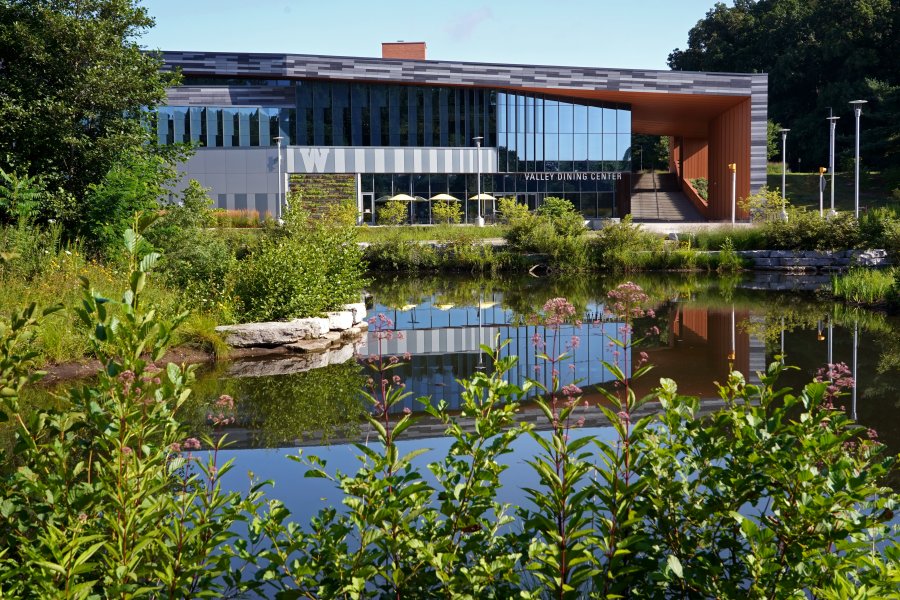
Valley Dining Center
The Valley Dining Center, which includes Cafe 1903 on the ground floor, received Gold level LEED certification for new construction in 2018. Valley Dining Center has a square footage of 62,921.

Student Center
The Student Center, which includes the Student Dining Center on the 3rd floor, along with retail food locations on the 1st floor operated by Dining Services received Silver level LEED for new construction in 2025. The Student Center has a square footage of 162,450.
Energy and Water Conservation
Both campus dining centers operate a pulper-extractor system which is part of the ware-washing and food waste system. This process replaces the traditional garbage disposal and uses a closed loop water system to rinse dishes before placing into the flight dish machine and also is used to turn the post-consumer food remnants into a "pulp" which helps to reduce the volume of food scraps. The resulting pulp is sent through the extractor which squeezes excess water from the pulp and returns to help rinse incoming returned dishes from the dining room. By using this pulper-extractor system, food scrap volume is reduced by an estimated 87% and water usage is reduced by an estimated 83%.
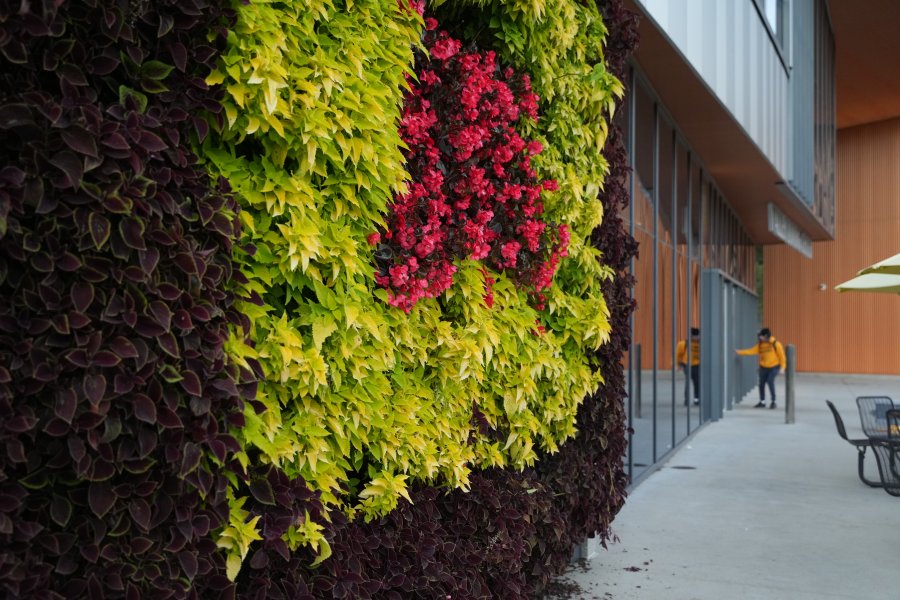
The Living Wall
The living wall is a feature on the south side of Valley Dining Center, which gets planted each year in the spring by Facilities Management.
On-going Sustainability Practices
Trayless Dining
Since 2008, campus dining centers have operated without trays, which are often used to aid in food selection but can encourage the selection of too much food. By removing the tray from the all-you-care-to-eat dining centers, students and guests typically select less food at one time, but are still welcome to return for more food. This practice results in less food waste at the end of the meal, because it encourages students and guests to eat in courses instead of selecting all food choices before sitting down to eat. In addition, there are also environmental savings that result from the decreased dish washing volume when trays are no longer used and thus do not need to be washed. The results in fewer cleaning chemicals being used, as well as less energy required to run the dish machines.
Recycled Napkin Dispensing
Dining Services replaced table napkins with Tork® Xpress napkin dispensing systems. To minimize waste and reduce the environmental impact, the dispensers:
- Use 100% recycled post-consumer recycled fiber napkins.
- Increases hygiene and cuts waste by delivering one napkin at a time.
- Utilizes a chlorine-free bleaching process that eliminates the release of damaging chlorine compounds into the environment.