

From Aviation Management to Artemis: Dan Kosters and the Logistics of Lunar Exploration
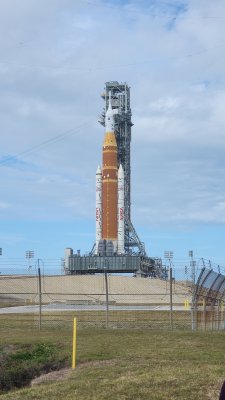
When the Artemis crew lifted off on its lunar mission, the hopes and dreams of thousands went with them, minus the G forces.
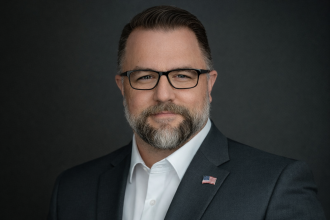
At least one of them has a connection to the WMU College of Aviation -- Dan Kosters, who received his degree in aviation science and administration in 2004.
Now a resident of Melbourne, Fla., and a retired Army officer as well, Kosters works for NASA at the Kennedy Space Center where he is involved in supply chain and logistics management to support current and future Artemis probes into the universe.
"I help plan, coordinate and execute the movement of critical materials and equipment that support mission readiness," says the former resident of Spring Lake, the Lake Michigan shoreline community due east of Grand Rapids. "Whether it is streamlining aerospace hardware supply chains, helping with advising on logistics design considerations, or planning the long-term sustainment strategy for Artemis, my work directly contributes to keeping missions on track from the ground up -- literally."
All of this began for the 1999 graduate of Spring Lake High School when he followed his childhood interest in everything aviation-related by taking part in an EAA (Experimental Aircraft Association) Young Eagles Camp at the nearby Grand Haven Airport. That morphed into a summer working at EAA's annual celebration of aviation in Oshkosh, Wis. The cherry on top was volunteering for the air shows held each summer in Muskegon and serving as a cadet in that community's Civil Air Patrol squadron.
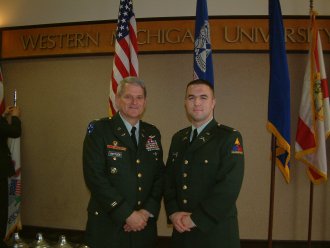
Aiming at a career that was involved in aerospace and the nation's defense, Kosters naturally looked at WMU, its aviation curriculum and its Army ROTC program. It seemed like a natural fit, and it was.
Not only did ROTC point him toward an Army career, he says, "it helped me with my degree pursuits and to build a core group of life-long friends." Plus, he wasn't the Lone Ranger when it came to peers who were both ROTC and College of Aviation enrollees. Dan explained that “Carpooling with friends from ROTC who were also studying aviation and goingfrom Kalamazoo to Battle Creek were some good memories.”
Kosters went on to do two tours of duty in Iraq with the 101st Airborne Division, which, he says, taught him "how to operate in a high-pressure environment, make quick decisions, and lead teams through complex and often unpredictable missions." One highlight was learning to rappel out of a hovering Blackhawk helicopter. Another was being a part of cargo drops into remote locations.
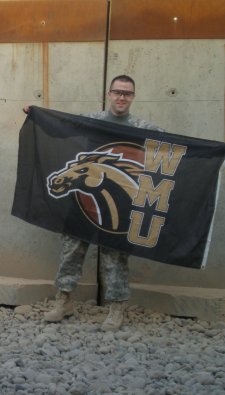
As the military years were logged, he transitioned into a logistics officer "where I found my niche coordinating large-scale operations, managing resources and ensuring that critical systems and personnel had exactly what they needed when they needed it." That's just what NASA would be wanting down the line.
Future assignments took him to Korea and later to the nation’s capital, where he served as a senior logistics supervisor at the headquarters of the U.S. Army National Guard. In that role, he oversaw maintenance budgeting as well as equipment overhaul and repair management for 54 U.S. states and territories.
Now his focus extends even further. “Looking ahead,” Kosters says, “I am excited to take on the challenge of coordinating sustainment efforts for future lunar systems, including landers, rovers, and drones operating on the Moon’s surface.” He adds that he is eager to contribute to “this next era of exploration.”
During his campus days, when Kosters wasn't in aviation classes or involved with ROTC activities, he worked in Western's recycling department, savored campus life, and enjoyed his hours at both Waldos -- the football stadium on game days and the watering hole near campus. Now a father of three, he hopes to return to “The Zoo” in the near future, both to revisit those memories and, perhaps, inspire his kids to follow in his footsteps as future Broncos.
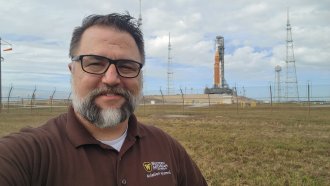
Kosters believes that getting to where he is today "has been a combination of the right foundation and the right experiences. My aviation education gave me a deep understanding of flight operations and systems, while my Army career built the leadership, discipline and logistics expertise required to operate at scale.
"NASA represents the intersection of those two worlds -- aviation and complex operational logistics," he says, "and has allowed me to continue serving in a mission-driven environment, just in a different capacity."
Like Han Solo slamming the Falcon into hyperspace, Kosters is itching to make the jump—hurtling at lightspeed toward whatever distant stars await. "With missions like Artemis III, IV and beyond already under way, along with the emergence of new companies supporting space operations, I can't wait to play a meaningful role in these efforts" -- such as the movement of critical supplies beyond Earth. "I want to help shape how we plan, deliver and sustain missions in space as human exploration continues to expand."
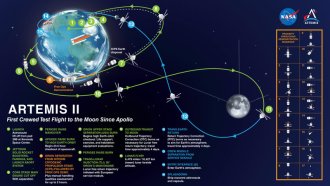
This constitutes what he enjoys the most about his current NASA duties. "It's turning dreams into reality," he says. "I value being able to draw on both my college experience at Western and my time in the Army in a single role" -- to contribute something significant in the aerospace field.
For those who would like to follow in Kosters' footsteps, he offers this advice. "Start thinking now about the future of space and how we will move people, equipment and supplies beyond Earth. We are entering a period of rapid growth in this field of endeavor. Stay focused and committed to your education and take full advantage of all opportunities. Even if your career path shifts, all those experiences can come back in unexpected ways and become valued assets. You never know where your journey will take you."
Kosters is an example of that. "Looking back," he says, "each step -- from WMU to the Army to NASA -- built on the last. And all of it has prepared me to support some of the most advanced and meaningful missions in the world today."