

Building Connections, Building a Career: Johan George's Aviation Journey
Request information about the College of Aviation
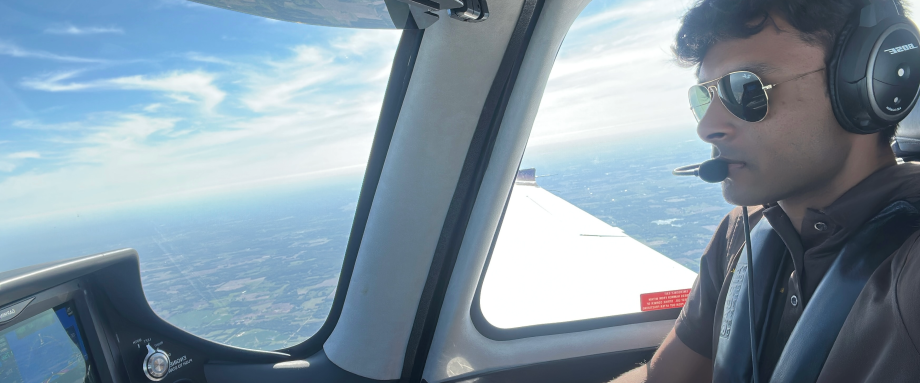
Johan George is learning that when you help others, you are really helping yourself.
The flight-science major, halfway between his junior and senior year in the WMU College of Aviation curriculum, serves as a student ambassador in the program.
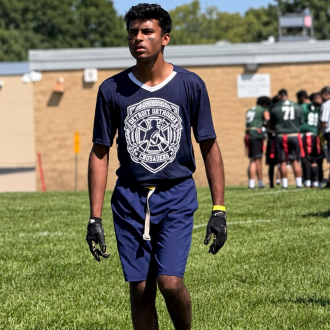
"I can represent WMU and pass on my knowledge that I have been learning," he says. "This is my first-ever job and through it, I am able to impact others, which is something I truly value."
Being an ambassador "has helped me grow in many ways," he says. "I talk to prospective students about our program, which not only helps others but also helps me break out of my shell and collect the best knowledge possible."
His "shell" was forged in the metro-Detroit community of Sterling Heights where he graduated from the Troy School District's International Academy East in 2024. The academy, established in 1996, was the first all-international, tuition-free public high school in North America.
His pathway toward a career in aviation started to be plotted in childhood with a fascination with airplanes flying overhead. "I regarded that as mind-blowing," he says. His fate was charted the moment he stepped into a plane. Becoming a pilot was for George.
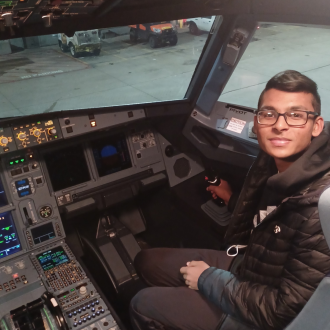
"Fate" happened when he was part of the Experimental Aircraft Association's Young Eagles initiative. In high school, George joined the Tuskegee Airmen where he experienced pilot ground school and earned his private pilot's license. He was affiliated with the Civil Air Patrol that refined his leadership skills and instilled in him the value of discipline.
He enrolled in physics and math classes, and in any other disciplines that would point toward aviation. The essays he
wrote always focused on some aspect of that topic. Any research targeted the industry.
When looking at higher education and advanced training, George cast a wide net that encompassed programs around the country, as well as "Part 141" and "Part 61" flight schools.
The "winner and still champ" was WMU for two reasons -- proximity to his home community and the quality of the training.
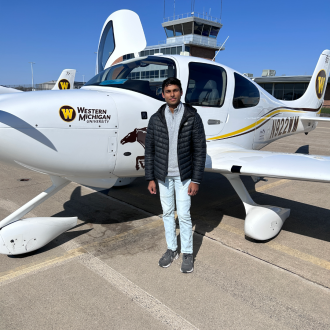
It was in the latter phase of his college research when Western came into focus. "The second I found out about it," he says, "I booked a tour, and that was it. What stood out was the quality of the program and its equipment." Another selling point was "the culture."
Part of the culture was the opportunity to join Western's chapters of Alpha Eta Rho, the aviation fraternity that links the industry with higher-education institutions, and PAPA, the Professional Asian Pilots Association. Both offer the chance to make "meaningful connections" and to network with industry professionals.
George believes that these activities formed "a better person, a well-rounded individual who is not just focused on my studies." The eventual product will be "a better pilot who can think more critically with more communication skills."
Non-WMU organizations are also playing a role in George's evolution. He's involved in Pilots for Kids, which offers an early introduction to aviation for youngsters, and in the student and youth spiritual wing of the Malakandra Orthodox Syrian Church, also known as the Indian Orthodox Church.
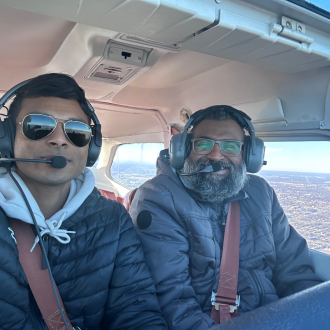
The favorite factor about his Western career is the College of Aviation itself. "I am there pretty much every day," he says. "It is a special place when it comes to my life and goals. It's where many people's dreams come true. It always reminds me of how lucky I am to be a part of a special community like this."
While his ultimate goal is to captain Delta Airline flights, his most-enjoyed class rests in another aspect of the college's aviation curriculum. It is the Aircraft Systems and Airframes course taught by master faculty specialist Matilda McLean. "I was able to learn about different types of frames and their construction. Although I had little interest in that aspect of the industry at the time, I really enjoyed that course."
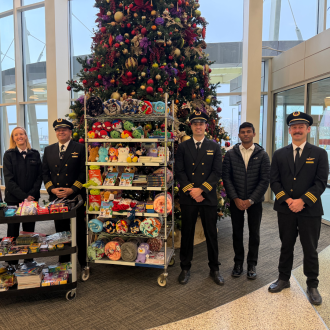
George along the way has been mentored by the likes of Sibin Samuel, who flies high-performance business jets for Executive Flightways Inc. as a captain, and Mosed Aiyash, a 2024 magna-cum-laude graduate of the College of Aviation who has been his flight instructor for three courses. "They have guided me through my aviation journey, added to my knowledge and strengthened my ability to make good decisions," he says.
"Aviation is not an easy thing," he says. "If it was, everyone would do it. Although my interest started at a young age, my research showed that becoming a pilot does not happen overnight. I've experienced many ups and downs, and most of that is out of anyone's control. All I think about now is moving on to the next rating or skill.
"I also try to think about past times." he says, "and where I am now. Here I am, living the life that once felt so far away. What needs to be done is to be more appreciative of myself and be thankful for myself and others who have helped me get this far."
Folks like Samuel and Aiyash, and the professionals before them who helped the duo get to where they are. People in the aviation industry have been passing it forward for a long, long time. And Johan George will have his chance to do that as well.